
Buying an industrial DTG printer is not like buying a standard DTG setup. In production, the printer is only one station in a system that includes garment prep, pretreatment, curing, QC, and rework control. The “best” machine is the one that hits your required throughput consistently while protecting uptime, scaling cleanly, and keeping total cost of ownership (TCO) predictable.
This guide is built for garment factories and high-volume print shops. It focuses on what actually drives output at scale: throughput math, uptime engineering, automation/maintenance, workflow design, scalability options, and TCO.
High volume dTG printer: How to calculate real throughput (not brochure speed)
A high volume DTG printer should be measured by finished, cured, shippable garments per hour—not only print time. In industrial production, the bottleneck often sits outside the printer: pretreat drying, curing capacity, loading/unloading rhythm, and reprints.
Start with a simple, realistic throughput model:
Throughput = (good pieces per hour) = (cycle capacity) × (first-pass yield)
- Cycle capacity comes from your slowest station (often curing or pretreat handling in dark-garment production).
- First-pass yield is the percentage of garments that pass QC without reprint (bad pretreat, head strikes, banding, under-cure, or color mismatch all destroy throughput).
What to do during vendor demos or pilot runs:
- Test your real art mix (fine detail + solid fills + gradients) on both light and dark garments.
- Time the whole loop: load → pretreat (if needed) → print → cure → QC.
- Record reprint causes. Even a small reprint rate becomes massive cost at scale.
A production buyer tip that competitors rarely state clearly: if you can’t keep the curing and pretreat stations fed and balanced, adding a faster printer won’t fix output.
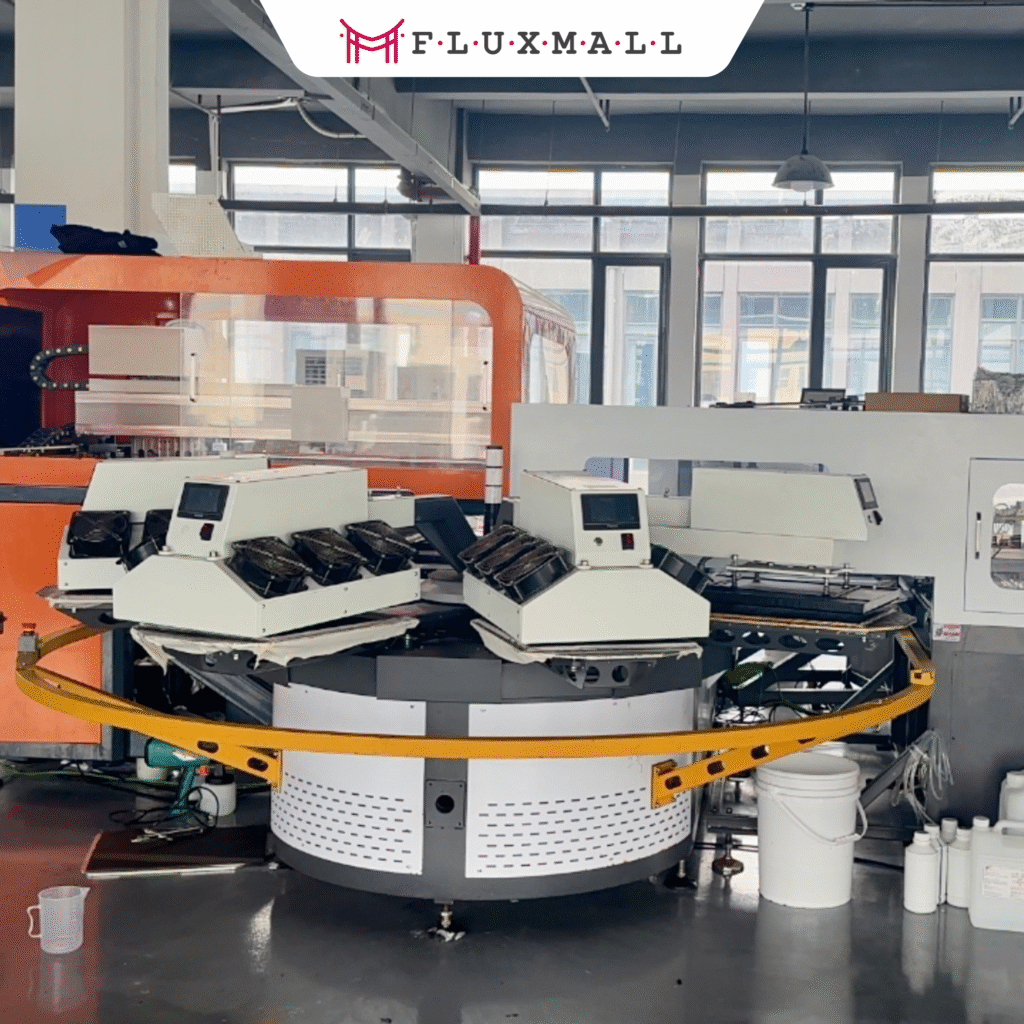
Production level dtg printer: Uptime, automation, and maintenance you can run across shifts
A production level dtg printer wins on stability. At factory volume, the main cost isn’t “the printer”—it’s downtime, operator dependency, and variability across shifts.
What to evaluate for uptime (in practical terms):
1) Maintenance minutes per shift
Ask vendors to show the real daily routine, not just the print quality. Your target is consistent output with a maintenance plan your team can execute without “hero operators.”
2) Automation that reduces variation
Features that matter in production are the ones that reduce human variability: consistent garment height/gap handling, repeatable platen alignment, and workflow controls that prevent wrong job / wrong size / wrong garment errors.
3) Service model and spare readiness
Industrial DTG isn’t a “set and forget” asset. Production buyers should evaluate:
- how issues are diagnosed (remote support, logs, guided troubleshooting)
- what parts commonly stop production
- how quickly you can recover to baseline output
If you’re building a long-term line, after-sales support quality becomes a throughput variable, not a nice-to-have.
Bulk ink system DTG: Ink economics, freshness, and multi-shift readiness
A bulk ink system dtg setup matters for two reasons: cost control and production continuity. In high-volume DTG, ink handling and consistency affect everything downstream: color stability, rework rate, and maintenance burden.
When you evaluate bulk ink for TCO, look past “price per liter” and ask:
- How does the ink system maintain readiness during multi-shift operation?
- What controls exist to reduce waste (purge routines, circulation management, predictable refills)?
- How stable is color output across long runs and across printers if you scale with multiple units?
Bulk ink can be a major lever in mass production, but only when it is paired with stable pretreat and curing settings. If your chemistry or curing is inconsistent, bulk ink savings get erased by reprints and returns.
Mass production DTG printing: Build a production workflow that scales cleanly
Mass production dtg printing works best when you design it like a line, not like a craft process. The workflow should be standardized, trainable, and measurable.
A reliable industrial workflow typically looks like this:
Order intake → art/RIP → garment staging → pretreat (as required) → print → cure → QC → pack/ship
Where factories gain (or lose) the most output:
Order intake and job control
Barcodes, job tickets, and clear “one source of truth” prevent wrong-file/wrong-size mistakes—one of the most common hidden causes of reprints.
Pretreat station discipline
Pretreat consistency drives color, sharpness, and wash durability. In production, you want repeatable application + controlled drying so that every operator gets the same result.
Curing capacity and layout
Curing is a throughput gate. If curing can’t keep up, the whole line backs up and operators start taking shortcuts (which increases defects). This is why many scalable systems are designed around a central curing flow with predictable garment movement.
QC as a throughput protector (not a delay)
QC doesn’t have to slow you down. A fast visual check plus periodic wash/adhesion validation protects first-pass yield and prevents costly downstream failure.
Textalk POD Solution (industrial DTG system): https://fluxmall.com/en/product/textalk-pod-solution/

DTG printer for garment factory: Scalability options and total cost of ownership (TCO)
A DTG printer for garment factory buyers usually choose one of three scaling paths. The right choice depends on your order profile (short-run variability vs repeated designs), garment mix (light vs dark), and how much automation you can justify.
Three common scalability models
- Single industrial DTG line
Best when you want centralized control, consistent output, and fewer moving parts. - Pod / multi-printer cell around shared curing
Best when you want modular scaling and redundancy (one unit down doesn’t stop the whole cell). - Hybrid production for mass runs
Best when you need mass-production economics while keeping digital detail where it matters most (useful when you have large orders with complex artwork).
TCO: the cost model factories should actually use
Industrial DTG TCO is usually decided by five buckets:
| TCO bucket | What drives it in production | What reduces it sustainably |
|---|---|---|
| Consumables (ink/pretreat) | garment mix, coverage, pretreat discipline | stable presets, bulk strategy, reduced waste |
| Labor per good piece | load/unload rhythm, rework, workflow clarity | layout design, job control, operator training |
| Uptime cost | maintenance minutes, stoppages, service delays | preventive routines, support readiness, redundancy |
| Energy & finishing | curing method, dryer utilization | balanced curing capacity, right finishing for volume |
| Quality cost | reprints, rejects, returns | first-pass yield focus, QC checkpoints |
A factory-grade quote request should include more than the printer. Ask for the full production view: recommended pretreat approach, curing requirements, staffing assumptions, training, and ongoing support.
Next step: pilot the line before you scale
Before signing off on a large investment, run a short pilot using your real garments and designs. Your goal is not “best-looking sample”—it’s predictable throughput with low reprint rates and a maintenance routine your team can repeat every day.
Industrial DTG printer FAQ
What makes an industrial DTG printer “industrial”?
Production buyers typically mean higher throughput, stronger uptime design, and workflow integration that supports multi-shift operation—plus a service/support model that keeps the line running.
What’s the biggest bottleneck in high-volume DTG?
Usually not print speed alone. Pretreat consistency, drying/curing capacity, job control, and rework rates are the most common throughput killers.
How do I compare industrial DTG options fairly?
Use the same test pack for every demo: your garments (light + dark), your real art mix, and a timed end-to-end workflow measurement that includes pretreat and curing.